14/3/25

AM I A MARITIME ECONOMIST?


(HNP photo: the Piraeus container terminal)


This has been a question that I have struggled to answer recently. This blog is intended for those who consider themselves as maritime economists. If you do not, you may disregard it. 

The answer to this question is (depending on one's perspective):

a. YES

b. NO

c. MAYBE

A bit of rationale:

First of all, how is the field of "maritime economics" defined? The Stanford/Elsevier 2% global scientists databasewhich is based on the Science-Metrix journal classification system, has some 174 scientific "subfields", and "maritime economics" is not one of them (incidentally, "economics" and "agricultural economics" are).  So a scientist can not identify himself/herself as a maritime economist based on what is in the Stanford/Elsevier database. People who consider themselves as maritime economists (and there can be many) will have to settle for another subfield of the Stanford/Elsevier database as their primary subfield (for instance, logistics and transportation, economics, business and management, operations research, or other). Incidentally, this is not a matter of a direct, personal choice, as the database makes this determination for you automatically, based on the journals in which you publish. My own primary subfield is logistics and transportation. Obviously, there is an indirect, but very clear choice here, for it would be very unlikely for Stanford/Elsevier to assign me in the L&T category if the bulk of my papers were in (say) astronomy, neuroscience, or psychology.

To h@ll with this database, one may say. Who needs it? Is there another way to say if I am a maritime economist? 

Well, as far as education goes, I have a diploma in naval architecture and marine engineering (NTUA), a MSc in the same area (MIT), a MSc in shipping and shipbuilding management (MIT), and a PhD in ocean systems operations research (MIT). Do these degrees prove that I am a maritime economist? Not sure. 

Also I am a member (and also Council Member) of the International Association of Maritime Economists (IAME).  According to IAME, “maritime economics” shall include the study of economic, managerial and governance- related issues and effects appearing in a maritime context, including related to shipping markets, ports and the associated supply chains. Note however that  there may be scientists who may consider themselves as maritime economists but who are not IAME members (or may not have paid their dues). So IAME membership may be a clue on whether someone is a maritime economist, but not a perfect one.

How about teaching? Well, I have taught courses on maritime transport economics at MIT (together with the late Zenon Zannetos) and at NTUA (in fact 3 courses). Plus I have taught a variety of other maritime transport related courses at DTU and other places. Does this make me a maritime economist? Maybe yes, maybe no.

How about research? Here things get more complicated. Below is a list of the various research areas that I have dealt with in my official active academic career (1979-2023), as I compiled them about a year ago (in parentheses are number of journal papers, plus books, book chapters and refereed conference papers in each area- NUMBERS MAY NOT BE UP TO DATE):  

Vehicle routing etc (18)

Ocean acoustic detection (7)

Oil spills (32)

Ship automation, autonomous shipping (8)

Maritime safety and security (15)

Shortsea and coastal shipping (13)

Ports (14)

Green freight transportation and logistics (17)

Ship speed models and optimization (16)

Maritime emissions (73)

Other research (24) - these are diverse topics that do not fall under any of the above.

TOTAL: 237 (for more details see HERE

I have NOT put maritime economics in the list as a distinct research area, even though various papers in some of these areas might be considered to be under the maritime economics umbrella. 

Last but not least, I have been CEO of the port of Piraeus for some 5.5 years. Does this make me a maritime economist? I do not think so. 

So based on all of the above, in all honesty I can say that I really do not know if I am a maritime economist. Maybe I will wear that hat under some circumstances, maybe I will choose to wear other hats too, under other circumstances. Last year I and other NTUA fellow naval architects and marine engineers celebrated the 50 years jubilee from our NTUA graduation in 1974. 


Does it really matter much? I am not sure it does. 


PS And now, the punchline: stay tuned for a podcast of my professional career mainly from an operations research perspective. 

See HERE, released on 20 March 2025. 

PS2

More in the "Am I something" category: 

Am I a painter? See HERE
Am I a photographer? See HERE
Am I an operations researcher? See HERE
Am I a Scandinavian? See HERE
Am I a cook? See HERE


17/2/25

ΟΝ ΤΗΕ FWCI INDEX

 As if a zillion citation indices were not enough, I recently became aware of the so-called FWCI (from Field-Weighted Citation Impact) index, devised and maintained by Elsevier. See HERE for some information on this index. 

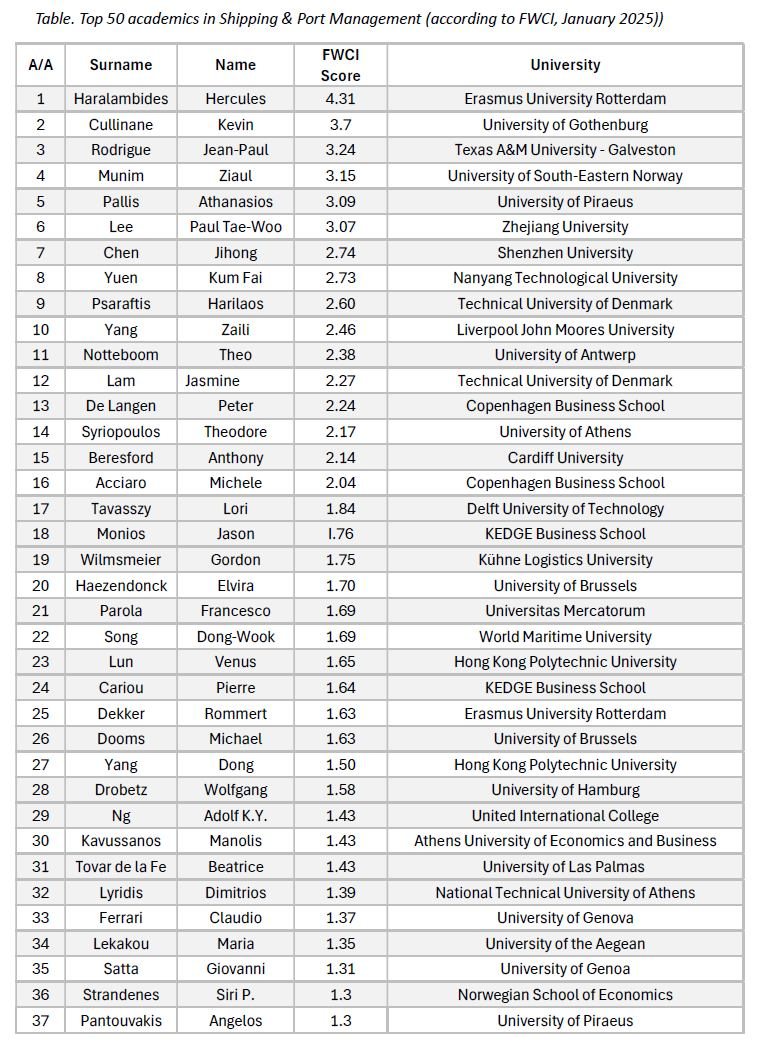
How did I learn about FCWI? (I admit I did not know anything about it). A colleague posted the following table on Facebook, which was reproduced from another colleague's post on LinkedIn (note that I have hibernated my LinkedIn account since about a year ago): 

(big apologies for the inconsistency in formatting)


The table lists the top 50, according to their FWCI index, academics in the field of "shipping and port management" (SPM). 

First of all, big congrats are due to all these people for making that list. I note that I am also included in it, in the No. 9 position, which is probably a surprise as I have only published very few port management papers. I have also published some papers that could, conceivably, fall under the general rubric of shipping management-  if one finds a way to explicitly define the field (more on this later). I also note that most of my own citations are in the vehicle routing area, with little or no connection to shipping and port management. 

Needless to say, there has been a big publicity splash on social media about this table, especially by people who are near the very top of the table. All of these people feel happy about their position in that table. 

As for me, I have some questions and comments about the table:

1. How was this table produced? I entered the FWCI site and I found no way to enter  "shipping and port management" as a filter or criterion or discipline, to see who is included in the area. A colleague who tried doing this by hand, produced another table. His question on how the table was produced went unanswered. 

2. A more basic question is, how is the SPM field defined? The Stanford/Elsevier global scientists database lists more than 160 scientific subfields (as they are known), and SPM is not one of them. Is a paper on ship weather routing an SPM paper? Probably. How about a paper on reducing maritime emissions, or a paper on finding the best risk control options to mitigate oil pollution? Or a paper on port regulatory policy? Or a paper in intermodal logistics? Here it is not so clear. So there is an identity problem to start with, and two different people may have different opinions on this subject. 

3. There is no direct mapping between SPM and any of the 160+ Stanford/Elsevier designated subfields. We can not say, for instance, that SPM is a subset of the "Logistics and Transportation" (LT) subfield, even though many researchers of the above SPM table have LT as their primary Stanford/Elsevier subfield. There may be other researchers who have other primary subfields in the Stanford/Elsevier database (for instance Operations Research, Economics, Business and Management, or other) and who may claim to be into SPM as well. 

4. But even if we find a way to explicitly define SPM, the next question is, who qualifies as an SPM researcher? One who has all of his/her papers into SPM? Some of his/her papers? Or at least one of his/her papers? And who will make that determination? The researcher himself/herself, or someone else? (and who?) The Stanford/Elsevier global scientists database makes this determination automatically, using an algorithm that looks at the overall publication picture and assigns to each scientist in the database exactly one primary field and exactly one primary subfield.  But there is nothing equivalent for SPM.

5. How would these results differ if instead of SPM we had "shipping and port economics", "shipping and port logistics",  "maritime and port economics and logistics", or something related? 

6. There is more. I can identify several other people who have published some SPM papers, and thus could be in the above table, but were, for some reason, omitted. These include (order is random) Shuaian Wang (FWCI= 2.1), Qiang Meng (FWCI= 1.94), Michael Bell (FWCI= 1.58), Jan Hoffmann (FWCI= 4.40), Christos Kontovas (FWCI= 3.63), and Thalis Zis (FWCI= 2.26). And this is a non-exhaustive list. If these people were included in the table, some other people would have to be removed. The omission of these people brings back question No. 1. 

6. I see that my own FWCI (and I suspect everybody else's) refers to the time interval 2013-2024. Is that reasonable? For me, in that time interval I had 84 out of a total of 180 Scopus-listed publications. Why are the rest of these publications not relevant? 

7. What does Elsevier itself say about FWCI? It clearly states that this is a paper-level index and NOT a researcher-level index.  For more on this see HEREIt also has this caveat: "Highly cited publications for entities with a small scholarly output may skew the FWCI. This metric should be used with care when assessing performance." This means that it should not be used to compare individual researchers with one another. 

8. See also HERE for an article by the University of Liverpool on the pitfalls of FWCI. According to it, and among other things, a list of recent Nobel prize laureates has a subpar FWCI ("We ran all Nobel Prize Winners between 2018 and 2020 (a total of 25). We found that 10 (or 40%) had 2015-2020 SciVal scores < 2)

Based on the above, and even though I am happy to be included in this table, I would be a bit cautious on using FWCI, either for SPM, or for other scientific disciplines, as a criterion for individual researcher performance. 

See HERE for several prior citations blogs. 

PS (ADDED ONE DAY LATER, 18.02.2025)

My blog above found its way into LinkedIn (via a colleague). I could not see the discussion since I am not on LinkedIn, but I received an email by another colleague, who is at the very top of the table,  in which he partially answered my question No. 1: He clarified that, among other things, those who compiled the table- whom he did not name- intended to list academics who are members of IAME (the International Association of Maritime Economists) and have FWCI>1. He also mentioned that the compilers of the table did not intend to use it to make comparisons among researchers. 

I am not sure if this clarification and caveat were also shared in public or were only just for me.  

I note however that some people under No. 6 are IAME members but were omitted from the table nonetheless (reason: unknown). I do not think this may be fair to them, in spite of FWCI being a dubious index. Conversely, it is not clear if all people in the table are IAME members. But surely some are, including the President of IAME and some IAME Council members (I am one of them). With all the deficiencies of FWCI, I am not sure their being listed in this table is fair to them either. 

Has IAME been consulted in compiling this table? I doubt it.

All in all, and in addition to all the deficiencies of FWCI as per above, I think it is fair to say that the information in the above table is not accurate and can be misleading, particularly so long as it continues being circulated in social media for the purpose of highlighting, comparing and benchmarking individual academic performance and impact.




6/1/25

THE SIMITIS BLOG

Costas Simitis, PM of Greece 1996-2004: 

The man who left a significant political legacy and put Greece in the Eurozone. He also played a critical role for the accession of Cyprus to the EU. 


For me personally, he was the man responsible for my 5 ½ year tenure as CEO of the port of Piraeus (1996-2002). This has been the non-academic part -but surely an important part- of my overall professional career*. 


He was not afraid to pick someone who had zero connections to the political establishment (including himself) and zero prior experience in running a port. 


I am grateful for the opportunity and for his support. May he rest in peace.


* More on Piraeus when I was there can be found HERE.


3/1/25

THE GEOMETRY BLOG

Among the numerous scientific topics that I have dealt with in my academic career (thus far), which one do I like the best? The answer may surprise you.

GEOMETRY!

I have NEVER published a paper on geometry. I have only taken courses in geometry in high school and during my early undergraduate studies.

Was I good at geometry? I can not claim that I was a superstar, however I was not stupid either. I owe this to some teachers and professors who were brilliant enough for me to get interested.

I can still remember the geometry question in the 1969 contest of the Hellenic Mathematical Society (HMS), which went as follows:

Let AB be a given arc on a known circle, which is less than half a circle, C any point on that arc and E a point on the linear  segment AC such that (AE) = (2/3)(BC). Prove that as C moves on arc AB, the locus of point E is a known line (curve). 

(Note: let me know if you want to know the solution)

I also remember the statement of the President of the HMS Aristides Pallas that young people should be more interested in mathematics than in the Beatles.

1969 was my last year in high school and later that year (after that contest) I was accepted (after exams that also involved geometry, among many others) at the National Technical University of  Athens (NTUA) for my undergraduate studies.

I got an award in the HMS contest (which also included a question in algebra and one in trigonometry), but not the top one. I do not remember the geometry problems of the NTUA exams, nor do I remember the algebra and trigonometry problems of the HMS contest.

The pic below is from the HMS 1969 award ceremony, including Aristides Pallas (second from left), other luminaries, and other award recipients. Can you spot me in it?


My NTUA studies (in naval architecture and marine engineering) included projective geometry and some non-Euclidean geometry topics. I have forgotten most of them. Courses in marine hydrostatics and ship design had some geometrical content.

Later at MIT, when I switched to operations research, I encountered problems in graph theory which also had some geometrical content. For instance, Euler’s Seven bridges of Koenigsberg problem and the Chinese Postman problem. Also the vehicle routing problems that I dealt with in my PhD thesis as well as afterwards had some geometry content. My most exciting project at MIT was a project to develop graphics software for mathematical optimization courses on campus. I liked graphics because I liked geometry.

I may also say that the fact that I like (and practice) painting MAY be connected to the fact that I like geometry.

Why do I like geometry?  

Because it is a no nonsense, no-bullshit (no-BS) discipline. There are no “ifs, ands, or buts” in geometry. There is nothing more scientifically rigorous (and, I would say, mentally exhilarating) than proving a geometric property, or theorem.

A very simple example of the beauty of geometry is the 9-point circle, also known as Euler’s circle, which is a circle that, for any given triangle, passes through (a) the midpoint of each edge of the triangle, (b) the foot of each of the altitudes, and (c) the midpoint of the line segment from each vertex of the triangle to the orthocenter (where the 3 altitudes meet), as shown in the figure below.


For the fascinating properties of the 9-point circle (there are many), and for many more in geometry, there are no ifs, ands, or buts. No one can challenge them with squishy, BS arguments. BS has zero value here.

Geometry is not the only no-BS discipline. Mathematics, physics, and many engineering disciplines also have this property. I only mentioned geometry because I like it very much.  

Unfortunately, “no-BS” is not the case with some other topics. I have encountered such topics in my academic career (thus far), and the question which one may be the worst is a tough one. Yet, I would venture my opinion, and it is the following one:


SCROLL DOWN


SCROLL DOWN


SCROLL DOWN


SCROLL DOWN


SCROLL DOWN


SCROLL DOWN!!


AND THE ANSWER IS....


DECARBONIZE SHIPPING!

Decarbonization of shipping (read: maritime transport) involves efforts to reduce greenhouse (GHG) emissions from ships all the way to “net zero”, as per policy decisions at the International Maritime Organization (IMO), the UN agency tasked to regulate shipping. These emissions are currently around 3% of all anthropogenic GHG emissions and on the order of 1 billion tonnes of CO2-equivalent emissions per year.

This happens to be the area, among many others, in which I (either alone or with several co-authors) have channeled most of my research energy over the last 15 or so years and published most of my recent papers and other publications, outcomes of funded and non-funded research. These publications are (depending on what counts) over 60. My co-authors and I did our very best to publish in good peer reviewed journals, and most of these are considered top journals. We also did our very best to make our methods and models transparent and make concrete and non-fuzzy recommendations, useful to industry and policy-makers alike. I actually invite anybody to read these papers and challenge the above statement, which may obviously entail some personal bias.

To be fair, shipping decarbonization is not a pure discipline like geometry. It involves an array of many interlinked topics, including various areas of engineering, various areas of economics, various areas of environmental sciences, and various areas of law and regulation. It also engages a rather wide and diverse set of stakeholders, who have multiple and many times conflicting interests. So there is no Euclid or Euler here, and there are few or no “no-BS” theorems.

The objective to decarbonize shipping is a laudable one. But it would seem self-evident that any plan to achieve that goal should be based on a combination of two basic prerequisites: 

(a) a strong political will and 

(b) sound and solid scientific results, that would allow policy makers to know where we stand and to rigorously evaluate alternatives and their impact before making policy decisions on where we should go.

Yet, and in spite of lots of discussions and good intent by some people, sadly we are a long way to securing prerequisites (a) and (b) above. By and large, the process is plagued by the following deficiencies (list below is only indicative, and order is random):

1.   GHG emissions estimates are purely based on modelling, but the intricate models that are used by the IMO are non-transparent and involve billions of assumptions, several of which are hidden and/or dubious.

2.  Much of the policy process is driven by studies that are also based on non-transparent models, which have undergone only superficial peer review, or no peer review whatsoever.

3.  Instant credibility is given by media (social or other) to many of the studies that are mentioned in #2.

4.  The decision making process is highly political with lack of consensus on key issues.

5.  Key responsibilities are placed on wrong stakeholders (for instance ship owners instead of shipbuilders or fuel producers).

6.   Decarbonization indices (such as EEDI, EEXI, AER, EEOI) are dubious and may actually increase GHG emissions. 

7.    Guiding principles at the IMO (CBDR, NMFT) are conflicting.

8.    Lack of consensus leads to deliberate fuzziness on key decisions.

9.  Many of those decisions, fuzzy as these may be, are based on the lowest common denominator.

10.  Lack of sound governance and transparency principles pervades the IMO policy making process.

11.  Regional measures (eg EU ETS) may create distortions, loopholes and risk of carbon leakage.


And then, it got suddenly much worse!

THE FINAL NAIL IN THE SHIPPING DECARBONIZATION COFFIN: The outcome of the 2024 US Presidential election.

Trump is a sworn denier of climate change. Under him it is inconceivable that the US will agree to any form of carbon pricing (or levy) to reduce GHG emissions, which is in my opinion, the only way forward. The US did not agree to it under the Biden administration either, even though they were surely more proactive than under Trump 2016-2020 (note: the US did not agree to the IMO 2018 Initial Strategy). China and a bunch of other countries do not agree to carbon pricing either. They never did, and are adamant against it. That makes the prospect of any sensible agreement by 2025, the year the IMO is supposed to agree on how to achieve net 0 by 2050,  all but impossible. 

The key word above is "sensible". Any agreement that does not include a substantial carbon levy is not, in my opinion, sensible. 


So here is how I think it looks, sadly (obviously I hope I am wrong): 


So for the time being, and as far as I am concerned, I prefer geometry.


PS (Dec. 2025) 

Was I a prophet? 

See HERE


28/10/24

AM I A PAINTER?


The purpose of this blog is to shed some light into my (amateur and less than illustrious) painting career. I will show you some paintings of mine. 

Note: the real paintings are much better, and what is shown here does not reveal the dimensions of the paintings.

THE EARLY DAYS

My painting career started when I was around 11 (1962), by copying, together with my father, the following Vincent Van Gogh painting:

THE COPY


THE ORIGINAL


Then we painted together this ship, named BREMEN. I do not have a pic of the original.


About a year later, when I was 12, I painted this ship alone (again, no pic of the original):


Then there was a painting of 4 Minoan fishermen that regrettably was lost (but see later). 

Then there was this Clipper painting, probably the Cutty Sark, which I recently fished out. Date is unknown, but it was done probably when I was in high school, mid 60s. I had it in my room in my parents' house in Athens, and it was packed for the last 15 years or so.


THE MIT DAYS

When I was a graduate student at MIT, and just before I took my Doctoral exams (1976, age 25), I started copying the Claude Monet painting, "le train dans la neige". 

But I did only 2/3 of the painting (the left hand side), and left the rest undone. I completed it 13 years later, when I had returned to Greece (1989, age 38).

COPY


ORIGINAL


THE NORDIC DAYS

There was a huge gap (31 years) between 1989 and 2020, when I resumed painting, in the middle of Covid. It was another Claude Monet painting, showing sunrise in the port of Le Havre. Age: 69. 

COPY

ORIGINAL


Then, in 2021 (age: 70), I experimented with a number of paintings, mostly NOT copies, but I drew whatever came to my mind, in a quasi-random fashion.


The pic above is a free-lance copy of the following photo, which I took in 1963, when I was 12. The silhouette that you see is my father. The setting: sunset off cape Sounion, onboard SS Limnos, going to Sifnos. I took the photo with a Kodak Brownie, and apparently it was so good that it was published in EIKONES, a magazine. Big discussion on Facebook: is my father looking at me, or at the sea? I do not know the answer. 


Then, here is some fish!


Painting a containership was a challenge. All lines parallel to the center-line of the ship converge to a point on the horizon. The name of the ship is SHANE.

Then we move into 2022, age 71. The one below is a random set of geometrical segments.


Then I decided to redo the Minoan fishermen that I did when I was a child and which were lost, this time three of them. They are three separate paintings.


The one below is kind of crazy,

The building in the one below is inspired by my house in Sifnos, however the colors and the background with the sea are different.


The one below is a liberal rendition of Kamares (Sifnos) from Agios Symeon.

The one below is inspired from Faros (Sifnos). This was done in 2023.


LAST BUT NOT LEAST!

The one below maybe is boring. The number of distinct colors is 17. This is, to date, my most recent painting, done in the fall of 2023.


Where are these paintings? Except the train and the clipper, which are in Athens, all are in Sifnos*. All Nordic paintings are acrylic, everything else is oil.


*The number of paintings in the Sifnos house is about 90. Except for the above, the rest was done by my father, who was a better painter than me, and far more prolific. There are many more paintings by him, in other places. 


19/9/24

CITATIONS MADNESS CONTINUES

The Scream, by E. Munch

It's that time of the year. The 2024 edition of the Stanford/Elsevier top 2% scientists database has been released on Aug. 1, 2024, going up to year 2023. The selection is based on the top 100,000 scientists by c-score (with and without self-citations) or a percentile rank of 2% or above in their sub-field. The c-score is a composite index based on as many as 40 different citation data for each scientist. The database actually contains entries for more than 200,000 people. See HERE.

I spotted the release a couple of days ago by accident (last year's edition came later, in Oct. 2023), and I announced it on Facebook with a concise statement of my own stats, which are as follows:

As in previous years, my own primary sub-field is Logistics & Transportation (L&T), and I am globally ranked No. 34 for this sub-field on a career basis, and No. 22 on a single year (2023) basis. Last year's numbers were No. 37 and No. 25 respectively, recording a marginal improvement over the years (a few years before I was No. 39). This improvement is perhaps a surprise, given that (at least on paper) I have been working part time for about 3 years now. I also retired fully on 31.12.2023, so I expect that at some point in time my stats will begin to be abysmally bad.

On a career basis: The number of scientists of 5 or more citations rose to 10,257,575 in 2023, up from 9,617,763 in 2022. Of those, 28,891 people have L&T as their primary sub-field (up from 26,803 in 2022). Of the 28,891, the number of L&T scientists in the database (excel) that one can download is 562, and those in the top 100,000 are 153.

Dividing 34 by 28,891 yields 0.001177 or about 0.12%, which means that I am in the top 0.12% of my subfield, on a career basis. That number was 0.14% last year and 0.16% a couple of years before. Quite honestly, I was expecting that number to go up, not down, and I realize that variation in all these numbers is within the realm of statistical noise. 

What is the importance of these numbers? I honestly do not know, and I have expressed my views on citations on numerous occasions before, see HERE for various blogs. I still remember a colleague boasting his own accomplishments,  inferring that since he was globally No. 20 or so on "WIDGET A analysis", he was the top influencer (globally No. 1) on "WIDGET B analysis", with "WIDGET A analysis" being a legitimate subfield in the Stanford/Elsevier database, whereas "WIDGET B analysis" was undefined in that database and was not necessarily a subset of "WIDGET A analysis". In a blog, I explained the fallacy of that reasoning. 

I have stopped having a Linked-In account since Jan. 2024 (I have not regretted it), so I have missed similar statements this year. But obviously, kudos are due to all people in the database. 

Irrespective of all this, I have the impression that bibliometrics is fast becoming a perversion, and that quite honestly it is way over-rated as a means to evaluate academic excellence. 

Other things are more important.